Beyond Detection: The "Explain It Back" Test That Actually Proves Your Work
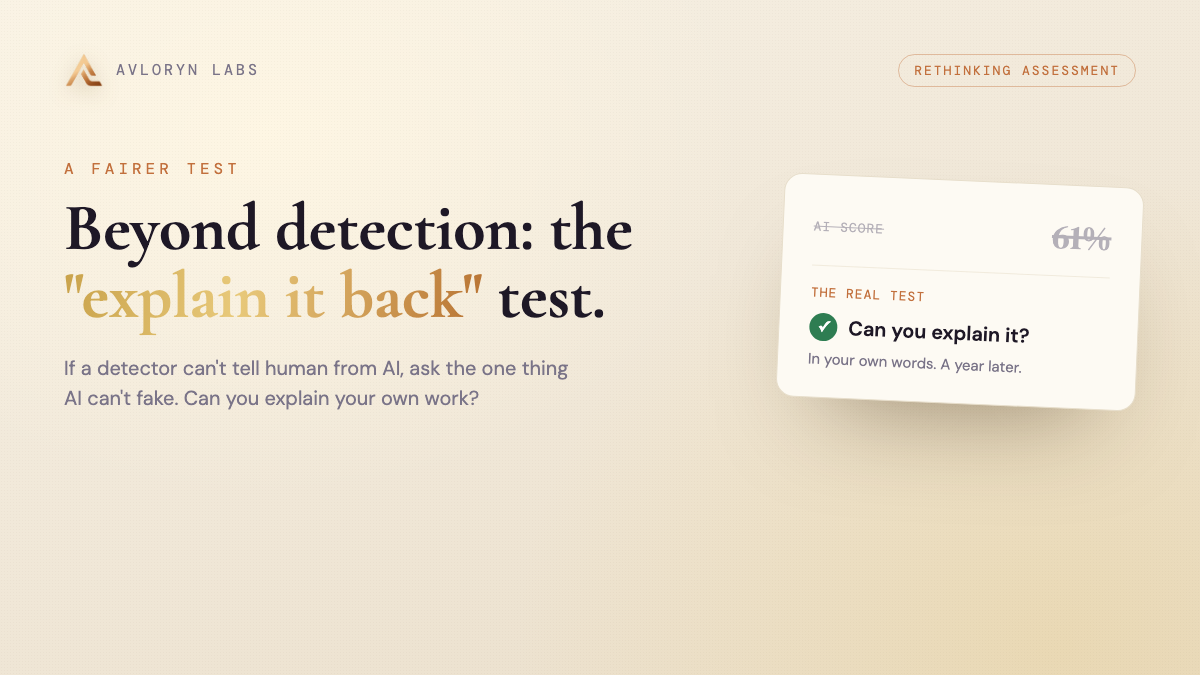
We have spent two years asking the wrong question. The question was never "is this text AI." It was always "does this student understand what they submitted." A detector can guess at the first. Only a person can answer the second.
The number was never the point
Detectors measure how a piece of text looks, not what a student knows. Even at their best they misfire, and as we covered in our piece on whether detectors can be wrong (https://avloryn.com/blog/can-ai-detectors-be-wrong), they misfire unevenly.
Who actually pays for a bad detector
A Stanford study led by James Zou tested seven detectors and found they flagged 61% of essays by non native English writers as AI, while flagging native writers at close to zero. The cause is mechanical. Detectors reward lexical variety and complexity, and second language writers, along with neurodivergent students and anyone who writes plainly, score lower and look more AI. So the students most likely to be wrongly accused are the ones with the least power to fight back. Most Indian students, writing in English as a second language, sit squarely in that group. This is not abstract. UC Davis students Louise Stivers and William Quarterman were both accused over work they wrote themselves.
A rule borrowed from the workplace
A manager who runs project teams once framed it perfectly. Use whatever tools you want, but if you cannot walk me through the reasoning in your own words, it is not done. That explain it back test filters AI misuse better than any detector, because it checks the one thing a tool cannot hand you. Understanding.
Academia already invented this test
It is called a viva. Oral defence, viva voce and interactive orals are being recommended across higher education right now, precisely because they test real time reasoning, applying knowledge to a fresh prompt and defending your own decisions. We reserved the viva for PhD scholars and told ourselves it could not scale. The AI era is exactly the reason to bring a lighter version of it back for ordinary coursework.
What it looks like in practice
Short oral checks. In class reasoning. Walk me through your method conversations. Drafts and version history as evidence of process. The goal shifts from "did AI touch this" to "can you own this." It is a fairer bar, and it quietly rewards the students who actually did the work.
The test that outlasts the semester
Here is the version I keep returning to. Forget the AI percentage. Ask whether a student can still explain their work a year later. If they can, they learned it, tool or no tool. If they cannot, no detector score was ever going to fix that. Change what we test, and the generation everyone fears will go blank becomes sharper instead, because the tool takes the grunt work and their head stays on the thinking. It is also why humanizer shortcuts miss the point entirely (https://avloryn.com/blog/ai-humanizer-tools-trap-students).
Where we stand
This is exactly why LivoDraft is built around ownership, not evasion. You bring your research, it helps you draft and reference it, you put it into your own words, and you get a signed disclosure. So when someone asks you to explain it back, you can. Start a draft at https://livodraft.com.
LivoDraft, from research to submission, faster with AI.
General information, not legal advice. Follow your institution's policy.
FAQ Can AI detectors reliably tell human from AI writing?
No, especially for non native English writers.
What is the explain it back test?
Asking a student to explain and defend their work in their own words.
Why are oral exams returning?
They test real time reasoning that AI cannot fake.
Are AI detectors biased?
Yes. A Stanford study found 61% false positives on non native English essays.
Get new writing in your inbox
Occasional notes on building intelligent software. No noise.