Can an AI Detector Be Wrong? Even Turnitin Says Yes (2026)
Every semester now, a student somewhere opens an email that says their essay was flagged as AI written. They did not cheat. They wrote it themselves. And yet a number on a screen has put their degree on the line. So it is worth asking a simple question. Can that number actually be wrong?
Can an AI detector actually be wrong?
Yes. This is not a student conspiracy theory. It is what the companies that build these tools say in their own words. A detector does not know you used AI. It makes a statistical guess about how predictable your writing looks, and a guess can be wrong in both directions.
What Turnitin itself says about its AI score
Turnitin states in its own guidance that its AI writing detection "may not always be accurate" and "should not be used as the sole basis for adverse actions against a student." It also says the score should not be treated as conclusive evidence of misconduct. Turnitin advertises high accuracy, yet in the same breath acknowledges a small risk of false positives. Read that again. The maker of the tool is telling institutions not to punish a student on the score alone.
How often are honest students flagged?
Independent analyses put false positive rates between 5% and 20%. When Vanderbilt University disabled Turnitin's AI detector in 2023, it did the math out loud. At a 1% false positive rate across the 75,000 papers it had submitted the year before, roughly 750 genuine student papers could have been wrongly flagged. Curtin University and several University of California campuses have stepped back for similar reasons. These are not hypotheticals. UC Davis students Louise Stivers and William Quarterman were both accused for work they wrote themselves.
Why Indian students face a higher risk
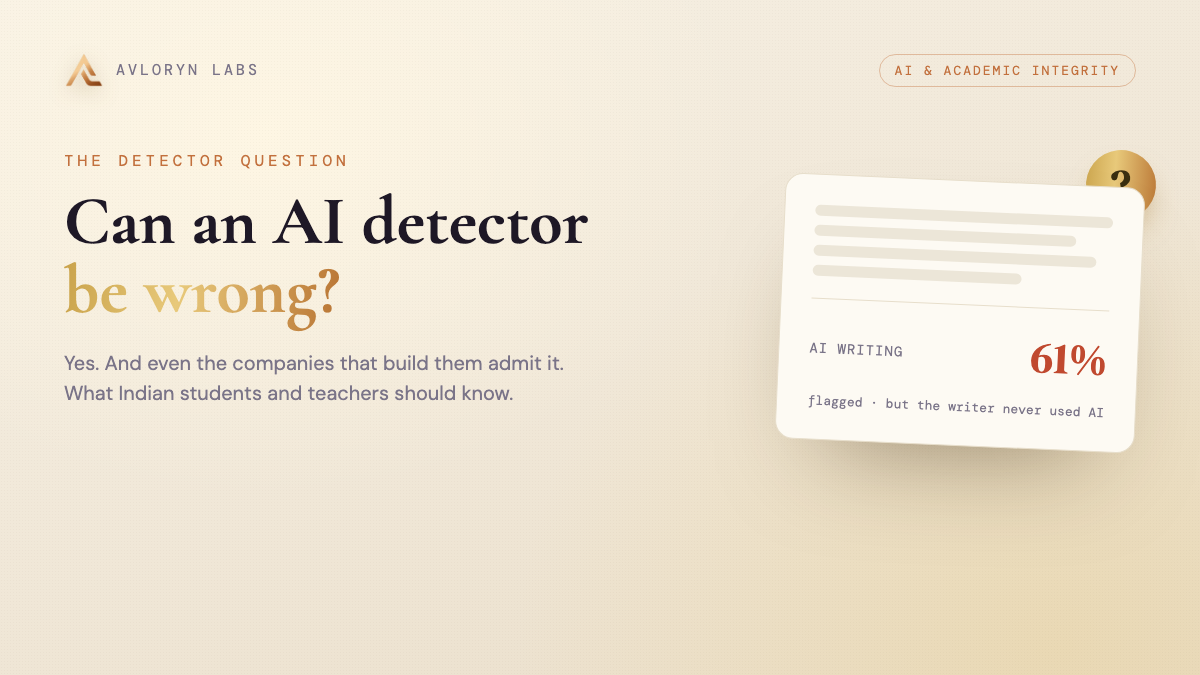
A Stanford study led by James Zou tested seven popular detectors and found they flagged 61% of essays by non native English writers as AI, while flagging native writers at close to zero. The reason is mechanical, not fair. Detectors lean on measures like lexical diversity and sentence complexity, and writing in a second language often scores lower on exactly those measures. Since most Indian students write in English as a second language, this bias lands on us hardest. It also hits neurodivergent students and anyone who writes in a plain, direct style.
What about DrillBit, the tool most Indian universities use?
In India the more common checker is DrillBit, used across 700 plus universities including IITs and NITs, and integrated directly with the Shodhganga national thesis repository. DrillBit is a capable tool, but its own guidance is the same in spirit. A result is a signal for review, not automatic proof. The caution is not about one brand. It applies to the whole category.
So what do UGC and AICTE actually require?
UGC's 2018 plagiarism regulations are still the primary rulebook, and as of 2026 UGC has not issued a separate notification on AI generated content. AICTE, which declared 2025 its Year of Artificial Intelligence, has been the clearest so far. Under its framework, AI used without acknowledgment is treated as plagiarism, and disclosed, acknowledged AI use is the accepted path. Notice what the rule is about. Honesty and disclosure, not a magic detector percentage.
If your honest work gets flagged, what should you do?
Do not panic, and do not assume you did something wrong. A score is not a verdict. Ask your department for its written policy. Keep your drafts, version history, notes and sources, because they show your process. Ask for a conversation, not just a number, and be ready to walk someone through how you actually built the work. In most fair processes, a student who can explain their own reasoning is on very solid ground.
A fairer test than a percentage
If a detector cannot reliably tell human from AI, what can? Increasingly, educators point to the oldest answer in academia. Ask the student to explain and defend the work out loud. We go deeper on that in our piece on the "explain it back" test (https://avloryn.com/blog/explain-it-back-test), and on why humanizer shortcuts backfire (https://avloryn.com/blog/ai-humanizer-tools-trap-students).
Where we stand
At LivoDraft we build for that world, not against it. You bring your own research and findings, LivoDraft helps you turn them into a properly formatted, real referenced draft, you put it into your own words, and it gives you a signed AI use disclosure you can hand to your department. So you are never chasing a detector number. You have work you can disclose, and work you can defend in a viva. You can start a draft at https://livodraft.com.
LivoDraft, from research to submission, faster with AI.
This article is general information, not legal advice. Always follow your own institution's policy.
FAQ Is a Turnitin AI score proof of cheating?
No. Turnitin itself says the score should not be the sole basis for action and is not conclusive evidence.
Can an AI detector flag writing that is 100% human?
Yes. Independent studies and the detectors' own makers acknowledge false positives.
Are non native English speakers flagged more often?
Yes. A Stanford study found 61% of non native English essays were wrongly flagged as AI.
What AI percentage counts as a fail?
There is no universal number. Institutions set their own policy, and a percentage alone is not proof.
Can you challenge a false AI accusation?
Yes. Ask for the written policy, share your drafts and process, and request a review rather than accepting a score as final.
Get new writing in your inbox
Occasional notes on building intelligent software. No noise.