
Why "AI Humanizer" Tools Are a Trap for Students
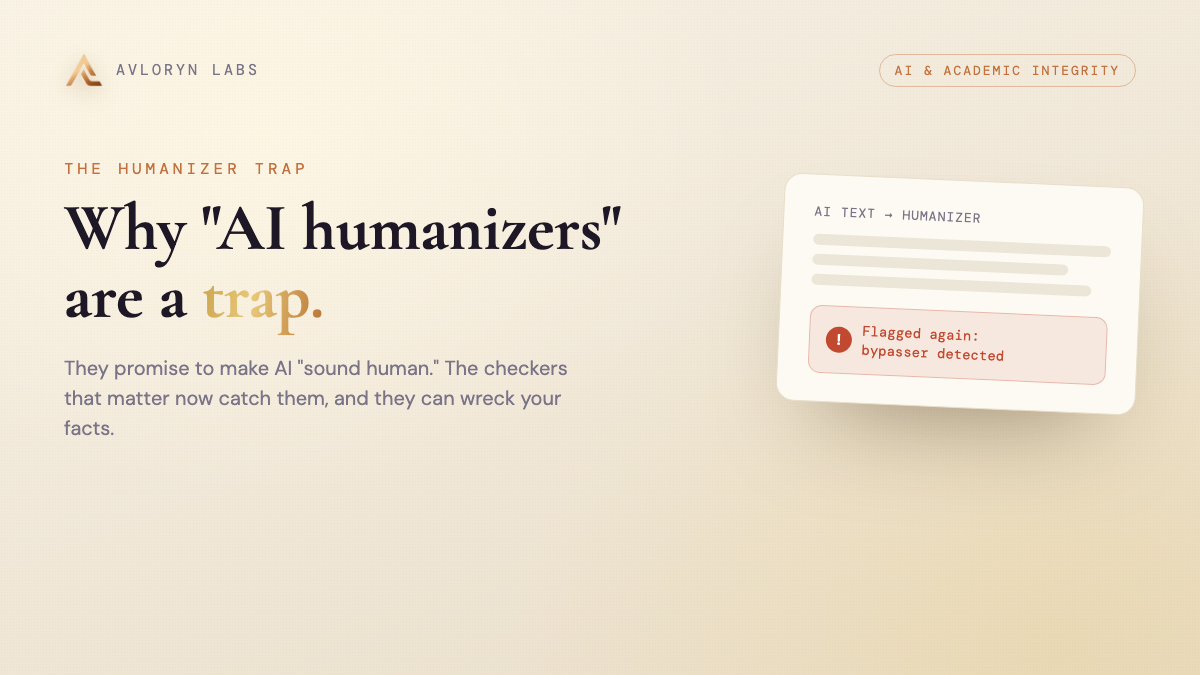
There is a whole industry now built on one promise. Paste your AI text, click a button, and it comes out sounding human. To a student staring at a detector score the night before submission, that sounds like magic. It is closer to a trap, and here is why.
What an AI humanizer actually does
It rewrites AI generated text to remove the patterns detectors look for. Some do it by swapping words and loosening sentences. Many do it by deliberately inserting small errors, odd phrasing and slang, because messier text scores as more human. Read that plainly. The tool makes your writing slightly worse on purpose, and calls that a feature.
The checkers that matter already catch them
Independent testing is consistent. Humanizers can beat weak free detectors, but they fail against the ones colleges actually use, like Turnitin, Originality and Copyleaks. And in August 2025 Turnitin rolled out AI bypasser detection, built specifically to flag text that has been pushed through paraphrasing and humanizing tools. So the very move meant to hide AI can now raise a second flag on top of the first, marking the work as manipulated. Some colleges say they have already caught hundreds of students this way.
They can quietly change your facts
This is the part students underestimate most. Heavy rewriting drifts from your original meaning. In research or technical writing, a humanizer can alter a number, soften a claim into something you did not intend, or drop a grammatical error into a paragraph you will later be asked to defend. You are trading a detector score for a document you no longer fully control.
Even if it works, it is still misconduct
Set the technology aside for a second. The entire purpose of a humanizer is to conceal AI use from your teacher. Under AICTE's framework, AI used without acknowledgment is treated as plagiarism, regardless of the percentage. So a tool whose only job is to hide AI is, by definition, helping you break the rule, not follow it. "I ran it through a humanizer" was never going to be a defense. It is the confession.
The quiet irony
There is something almost sad in the loop students are now caught in. Use AI to write, use more AI to hide the first AI, then buy a detector to check whether the hiding worked. Somewhere in that cycle the actual learning, the thing a degree is meant to certify, quietly disappears. And when you sit in a viva, none of those tools can speak for you. This is the same reason a detector score was never the real test (https://avloryn.com/blog/explain-it-back-test), and why even detectors get it wrong (https://avloryn.com/blog/can-ai-detectors-be-wrong).
What to do instead
Use AI the way the rules actually allow. Bring your own research, let AI help you draft and structure it, then put it into your own words and disclose that you used AI. That is not a loophole. It is the compliant path AICTE describes, and it is the only version that survives a viva, because you can explain every line.
Where we stand
LivoDraft is built on that principle, not on hiding. You bring your research, it helps you turn it into a properly formatted, real referenced draft, you make it your own words, and it gives you a signed AI use disclosure you can hand to your department. No humanizer, no bleaching, nothing to get caught for. Just work you can put your name on. Start a draft at https://livodraft.com.
LivoDraft, from research to submission, faster with AI.
General information, not legal advice. Follow your institution's policy.
FAQ Do AI humanizers beat Turnitin?
Not reliably. Turnitin added bypasser detection in 2025 that flags humanized text.
Is using a humanizer cheating?
Its purpose is to hide AI, which AICTE treats as plagiarism when undisclosed.
Can a humanizer change my meaning?
Yes. Heavy rewriting can alter facts and introduce errors.
What is a safer alternative?
Disclose your AI use and keep work you can explain.
Get new writing in your inbox
Occasional notes on building intelligent software. No noise.